
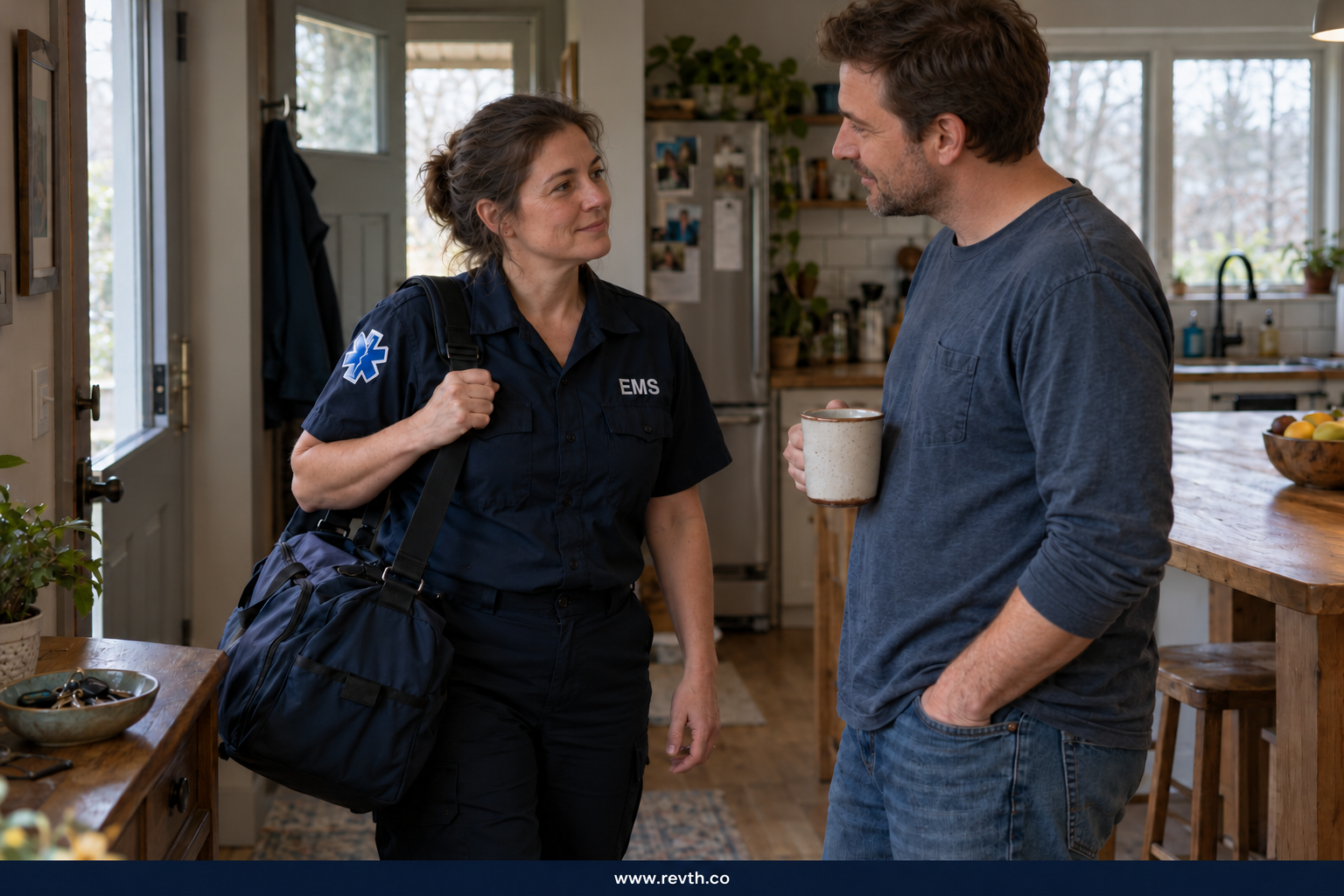
After Shift Mental Health Routine for First Responders

The Ten Feet Between the Car and the Front Door
- A short pause can mark the transition home without requiring you to explain the whole shift.
- A clear request and an agreed time to reconnect give everyone at home less to guess about.
- Persistent distress deserves professional attention, and workplace conditions need organizational action.
If coming home after a demanding shift feels harder than you expected, try a brief transition: pause somewhere safe, notice your surroundings, and tell the person at home what you need next. Treat it as an experiment you can adapt. A routine cannot resolve trauma, exhaustion or problems at work, but it can give an otherwise awkward arrival a little structure.
You turn off the engine. The porch light is on. Inside, someone may be waiting with dinner, a question about the car or a child who wants your attention. You are glad to be home. You also do not feel ready to answer anything yet.
That moment can belong to a dispatcher leaving a headset behind, a paramedic after a long shift, a police officer finishing reports or someone returning from Guard duty. It can also belong to the spouse who has handled the entire evening alone. Both people may need a pause. Neither should have to guess what the other means by silence.
Begin with a pause you can actually use
Once you are safely parked, take a moment before opening the door. Leave the phone alone. You might rest your hands, feel your feet against the floor or simply look toward the house. If remaining in the car feels uncomfortable, choose another place: the porch, a quiet hallway or the few minutes after changing clothes.
There is no required length. Ten minutes is an example to discuss together, not a clinical recommendation. On a busy evening, thirty seconds and a clear sentence may be more realistic. If you live alone, the pause can still mark the change from work responsibilities to your own evening.
Notice what is around you
Try naming five ordinary things you can see: the mailbox, a leaf on the windshield, a porch chair, the door handle, your bag. Choose neutral details. If looking around is not accessible or comfortable, notice a familiar sound or the texture of a sleeve instead.
VA describes using attention to present surroundings in its guidance on coping with traumatic stress reactions. The five-item suggestion here is a simple editorial adaptation, not a tested after-shift treatment. You do not have to complete it or feel calmer afterward. Stop if it makes you more uncomfortable. [1]
Make one request and include the return
“I’m glad to be home. I need ten quiet minutes. Then I want to hear about your day.”
That sentence gives the person waiting two pieces of useful information: you need a little space, and you intend to come back. Other requests may fit better: “Can we sit together without talking for a minute?” or “I need something to eat before I can have this conversation.”
Try agreeing on the routine during an ordinary day. Decide what happens when someone arrives late, when children need help immediately or when both adults are depleted. If you need more time than you expected, say so and arrange another check-in. A pause becomes harder to trust when it repeatedly turns into a whole evening of unexplained withdrawal.
The person waiting at home has needs too
A spouse or partner may also have finished a demanding shift, managed caregiving or spent the day carrying family logistics. Asking them to absorb every difficult arrival without support is not a workable plan.
A response might be: “Take a few minutes. I need your help with bedtime at seven, and I want us to check in afterward.” If you need immediate help, make that clear. You can be compassionate and still have a practical limit.
A private transition also does not require retelling a difficult call. “It was a rough shift and I’m not ready to discuss it” can be enough for now. You can talk about what would help at home without sharing work details or someone else’s private information.
Know when a small routine is not enough
If sleep problems, distress, irritability or withdrawal keep interfering with daily life, consider speaking with a qualified professional. NIMH recommends seeking professional help when stress or anxiety persists, becomes difficult to manage or disrupts everyday activities. You do not need to decide on a diagnosis before starting that conversation. [2]
Bring a concrete example: “After most shifts I sit outside for an hour, and my family is worried,” or “I keep canceling plans because I cannot settle.” Ask about appropriate care and what to do if you need help before the next appointment. A wellness exercise should never become a reason to postpone support that you need.
Workplaces have responsibilities beyond coping advice
An individual routine cannot repair inadequate staffing, repeated overtime or a confusing route to confidential help. Leaders can examine schedules, explain how support is accessed and make privacy rules and their limits clear. Employees should be able to ask who receives information and whether a service has any connection to employment decisions.
These are organizational questions worth asking alongside personal coping choices. Families should not become the only place where the effects of difficult work are handled.
Exploring additional support through Revolutionary Telehealth
Revolutionary Telehealth provides access to therapy through BetterHelp and mental wellness support through Calm Health. Revolutionary Telehealth operates as an MSO; clinical services are provided through the appropriate clinical service partner. Visit www.revth.co to explore the current options. Before subscribing, review costs, enrollment steps, privacy terms and whether the service fits your needs. [3]
Common questions
What if I want to be alone when I get home
Ask for a specific interval and say when you will reconnect. If being alone is becoming your default for most evenings and is affecting relationships, bring that pattern up with a qualified professional.
What if the routine does nothing for me
Change it or leave it. A shower, changing clothes or a quiet meal may suit your household better. This sequence has not been validated as a clinical protocol, and completing it is not a measure of how well you are coping.
Can I use this after drill or a civilian workday
Yes. Adapt the timing to your responsibilities. You do not need a particular job or a traumatic experience to make a clear request for a few minutes before reconnecting at home.
Sources
Primary guidance and Revolutionary Telehealth service information checked October 21 2026. Bracketed references identify the relevant sources; examples and household suggestions are original editorial content.
[1] VA National Center for PTSD — Coping with Traumatic Stress Reactions
[2] NIMH — I’m So Stressed Out Fact Sheet
[3] Revolutionary Telehealth — Current access options